
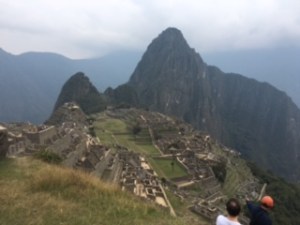
As friends on Facebook know, I spent the day yesterday at Machu Picchu, one of the more mysterious ancient sites dating from the pre-Columbian Americas. While the visit was worthwhile (astounding actually) in itself, I found some connections to my work on the history of food in Latin America.
Truth be told, we know very little about the lives of the Andeans who inhabited this site (though that won’t deter the tour guides from creating some histories!). As a general theme in world history, ancient structures of this caliber are generally assumed to have been built by stratified societies built on intensive agriculture. Yet as you can readily see from the photos, the terrain does not immediately seem to be as well-suited for agriculture as our beloved Indiana. Andeans developed an ingenious solution to this problem: terrace farming. Here are some terraces, probably centuries old, that I observed in farming communities on the way to the site:
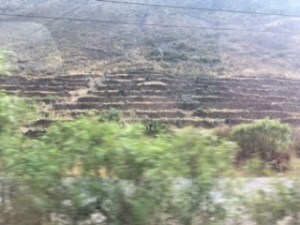
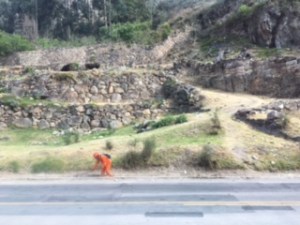
The pictures above were taken from the train. Most visitors typically stay in Cuzco and take the train to Machu Picchu, 3 to 3.5 hours each way. Some stay in Aguas Clientes, the town closest to the site. Trains in Latin America have been falling into disuse, which for many of us is a sad trend. Tourist-oriented trains have survived. The view is so much different from the tracks!
Stepping back a few days in my trip, I will share a couple photos taken from the bus ride from Argentina to Chile, as I crossed the Andes. A train track, no longer in use, paralleled our road the entire way. Historically, trains were established in Latin America (often by the British) to bring export products (including food) to the coast. I am a little surprised that a line was used to unite Chile with Argentina, though perhaps it was easier to ship goods from Chile to Atlantic ports than to sail around Tierra del Fuego before the construction of the Panama Canal. Historical mysteries….
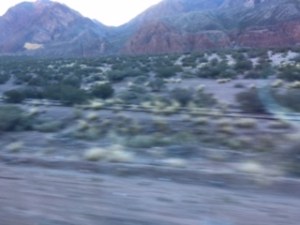
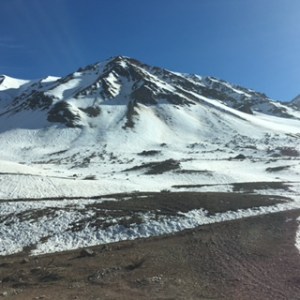
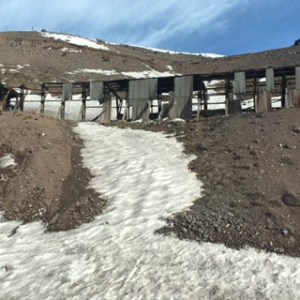
As we climbed into the Andes, twe saw the remnants of some snow coverings for the trains, no doubt used during blizzards when the crew needed to wait out the storm. I imagine that there are many lost stories hidden in the ruins of these tracks…
Ecological Adaptations and the Vertical Economy
South America features a wide variety of ecological zones, from tropical to frigid. Mediterranean climates such as that found in Mendoza (see earlier posts) have produced quality wines, as well. Andean peoples have been challenged by — and have benefited from — a variety of climatic zones. Dating back to before the Incas, Andeans have established what historians call a “vertical economy.”
Crops thrive differently at varied altitudes. Even one of the more flexible plants, maize, grows in different ways and rates depending on the altitude. I noticed this from my train window yesterday, as we traveled from Cuzco (elevation 11,000 feet) to Aguas Calientes (elevation 7000 feet). As you can see, the corn plants are at different states of maturity. (Of course, in Indiana the seasons are completely opposite so we are at the end of our harvest season!)
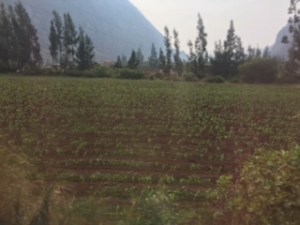
maize plants near Cuzco
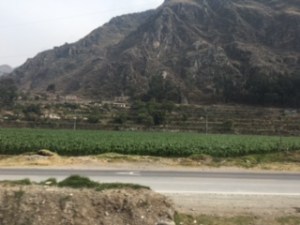
maize plants near Aguas Calientes
(taken from a longer distance… sorry)
Historically, Andean societies could control lands at different altitudes within their zone. This provided the opportunity to take advantage of crops within their season. More amazingly, they developed a technique for freeze-drying potatoes, by taking them to higher levels to freeze, then returning the product to storage at more temperate levels where they lived. The resulting product, still produced today, is called chuño (not my pic):

Solanum × juzepczukii hybrid or Solanum × curtilobum hybrid
For sale at the small market in Paucartambo, Peru
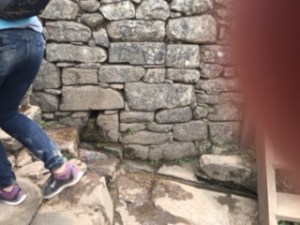
In addition to this brilliant use of altitude differences, Andeans learned how to control water before the time of the Incas, as can be seen from some of the plumbing I noticed in Machu Picchu:

Pre-Incan Andean foods continue to be produced and consumed in South America and around the world. My next post will focus on the exciting developments in New Peruvian Cuisine, which has achieved a global impact. I leave you with a few food photos from restaurants in Cuzco, which should show that the cuisine here is about much more than potatoes!
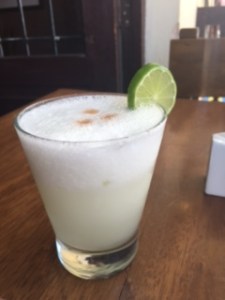
Let’s start with a pisco sour!

Ceviche with maize nuts and sweet potato

Grilled Alpaca (hidden under fresh tomatoes and onions) with yellow potatoes and rice. I thought it tasted somewhere between beef and venison. Quite lean.
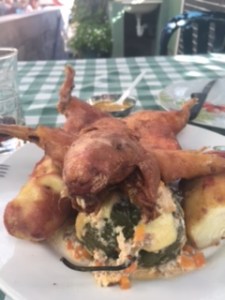
Fried cuy, resting on a chile reline with roasted potatoes. Not lean! Delicious.
(google “cuy” if you don’t know what it is!)
¡Buen provecho! I’ll be back after my trip to Lima later in the week!
 Chef Warner Stories