

Yes, there are vegetables in Argentina as well as meat and pasta! Artichokes (next to red peppers above) are in season. I remember those fondly from central coast California, where they thrive in the 50-60 F weather as they do here. I wonder who brought them here first?
Today I was on a bus for ten hours from Buenos Aires to Córdoba, the second largest city. As a Latin American historian I have long been aware that there are two Argentinas: Buenos Aires and the rest. Some have told me that France is this way as well. In the nineteenth century, porteños held court over the rest of the country, as liberals such as Sarmiento competed with countryside charismatic conservative leaders, or caudillos, like Rosas. Today the differences are not so marked perhaps, though the landscape surely is. Traveling across the long stretch of flat land called the Pampas reminded me of the US Midwest, if flatter:
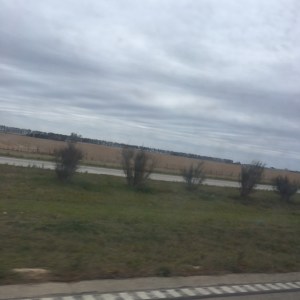
Lots of land for wheat, cattle, and other livestock. The British, who developed these industries a century ago, also saw it as a huge potential polo field. The air is crisp and dry, just the opposite of what I left behind in Indiana less than a week ago.
And yet I made another Hoosier connection, meeting up with Ben Finley ’15 at his “resi” or community house in Córdoba. We feasted on empanadas (I still have not spent a day without beef) and chatted with his Argentine housemates, most of whom were nervously watching their soccer team narrowly defeat Uruguay.
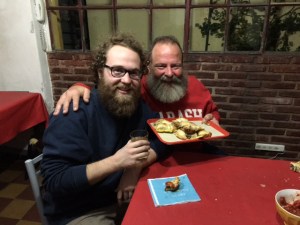
As I finished my last empanada I recognized that the two principal ingredients — wheat and beef — dominate the landscape for kilometers in each direction. And like much of Argentina, these foodstuffs were immigrants, brought by Europeans centuries ago. These migrations and new cuisines are the main ingredients in my research, as will be seen if you continue to follow my musings here!
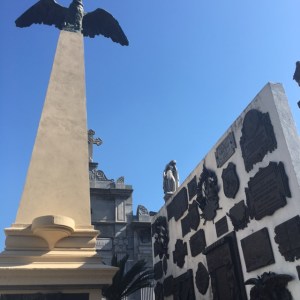
Back to BA one last time. I visited the Recoleta cemetery, a maze of mausoleum structures that date back over the last couple of cemeteries. Many key public leaders are represented, from politicians to the elite classes of previous generations. No two structures are alike, for example some have votive tables set up behind ancient glass, and some have stairs that travel into the netherlands.
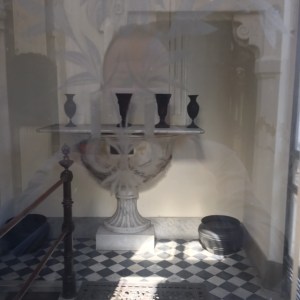
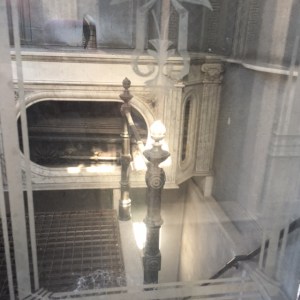
There is a map, but only one site has actual signs that lead to it, that of President Domingo Sarmiento. Interesting that I could not find Rosas. Here is the final resting place of Sarmiento:
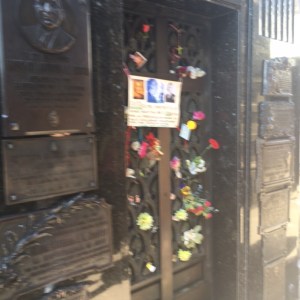
And finally, I believe that many of you will be able to guess which famous twentieth century woman was laid to rest here:
Tomorrow: some more connections I have been making between my reading and my immersion learning. ¡Buenas noches!
 Chef Warner Stories