
I have moved my blog to a more permanent location at chefwarnerstories.com. See you there!
Month: September 2016
Machu Picchu and Resource Management
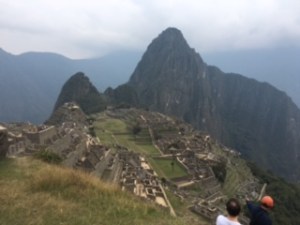
As friends on Facebook know, I spent the day yesterday at Machu Picchu, one of the more mysterious ancient sites dating from the pre-Columbian Americas. While the visit was worthwhile (astounding actually) in itself, I found some connections to my work on the history of food in Latin America.
Truth be told, we know very little about the lives of the Andeans who inhabited this site (though that won’t deter the tour guides from creating some histories!). As a general theme in world history, ancient structures of this caliber are generally assumed to have been built by stratified societies built on intensive agriculture. Yet as you can readily see from the photos, the terrain does not immediately seem to be as well-suited for agriculture as our beloved Indiana. Andeans developed an ingenious solution to this problem: terrace farming. Here are some terraces, probably centuries old, that I observed in farming communities on the way to the site:
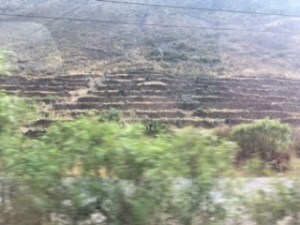
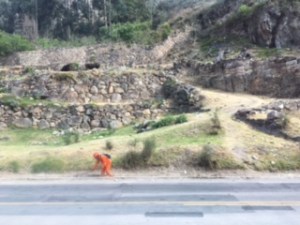
The pictures above were taken from the train. Most visitors typically stay in Cuzco and take the train to Machu Picchu, 3 to 3.5 hours each way. Some stay in Aguas Clientes, the town closest to the site. Trains in Latin America have been falling into disuse, which for many of us is a sad trend. Tourist-oriented trains have survived. The view is so much different from the tracks!
Stepping back a few days in my trip, I will share a couple photos taken from the bus ride from Argentina to Chile, as I crossed the Andes. A train track, no longer in use, paralleled our road the entire way. Historically, trains were established in Latin America (often by the British) to bring export products (including food) to the coast. I am a little surprised that a line was used to unite Chile with Argentina, though perhaps it was easier to ship goods from Chile to Atlantic ports than to sail around Tierra del Fuego before the construction of the Panama Canal. Historical mysteries….
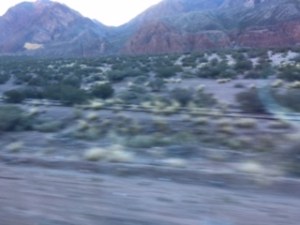
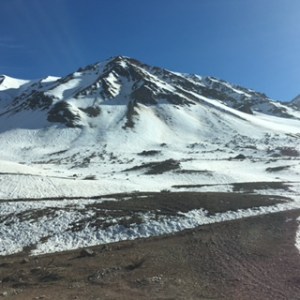
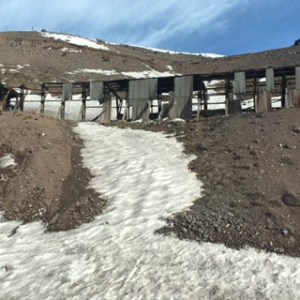
As we climbed into the Andes, twe saw the remnants of some snow coverings for the trains, no doubt used during blizzards when the crew needed to wait out the storm. I imagine that there are many lost stories hidden in the ruins of these tracks…
Ecological Adaptations and the Vertical Economy
South America features a wide variety of ecological zones, from tropical to frigid. Mediterranean climates such as that found in Mendoza (see earlier posts) have produced quality wines, as well. Andean peoples have been challenged by — and have benefited from — a variety of climatic zones. Dating back to before the Incas, Andeans have established what historians call a “vertical economy.”
Crops thrive differently at varied altitudes. Even one of the more flexible plants, maize, grows in different ways and rates depending on the altitude. I noticed this from my train window yesterday, as we traveled from Cuzco (elevation 11,000 feet) to Aguas Calientes (elevation 7000 feet). As you can see, the corn plants are at different states of maturity. (Of course, in Indiana the seasons are completely opposite so we are at the end of our harvest season!)
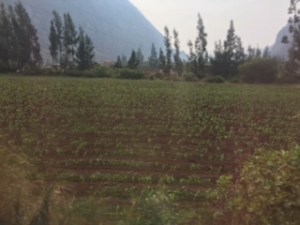
maize plants near Cuzco
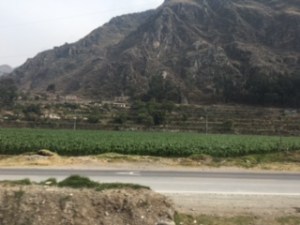
maize plants near Aguas Calientes
(taken from a longer distance… sorry)
Historically, Andean societies could control lands at different altitudes within their zone. This provided the opportunity to take advantage of crops within their season. More amazingly, they developed a technique for freeze-drying potatoes, by taking them to higher levels to freeze, then returning the product to storage at more temperate levels where they lived. The resulting product, still produced today, is called chuño (not my pic):

Solanum × juzepczukii hybrid or Solanum × curtilobum hybrid
For sale at the small market in Paucartambo, Peru
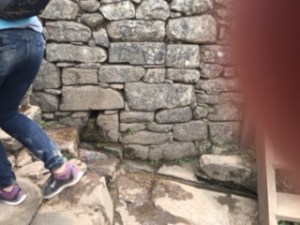
In addition to this brilliant use of altitude differences, Andeans learned how to control water before the time of the Incas, as can be seen from some of the plumbing I noticed in Machu Picchu:

Pre-Incan Andean foods continue to be produced and consumed in South America and around the world. My next post will focus on the exciting developments in New Peruvian Cuisine, which has achieved a global impact. I leave you with a few food photos from restaurants in Cuzco, which should show that the cuisine here is about much more than potatoes!
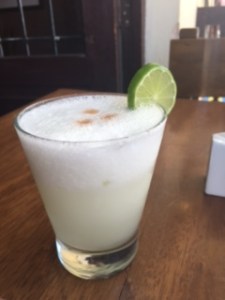
Let’s start with a pisco sour!

Ceviche with maize nuts and sweet potato

Grilled Alpaca (hidden under fresh tomatoes and onions) with yellow potatoes and rice. I thought it tasted somewhere between beef and venison. Quite lean.
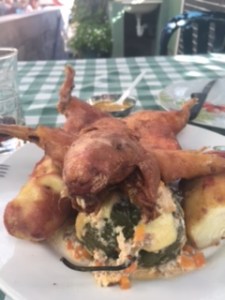
Fried cuy, resting on a chile reline with roasted potatoes. Not lean! Delicious.
(google “cuy” if you don’t know what it is!)
¡Buen provecho! I’ll be back after my trip to Lima later in the week!
Ancestral Cuisines
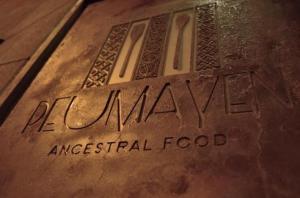
Yesterday I shared one of the most interesting meals in memory with Ben Finley ’14, who made the trip over from Córdoba Argentina for a few days. My larger academic purpose on this South American journey is to learn as much as I can, from an experiential level, about the history and memory of Latin American food. The restaurant Peumayen was right in this wheelhouse. I tasted over 30 small dishes that were created from historically important foods from before and after the arrival of Spaniards and subsequent Europeans. This is historical fusion at its best. I will try now to share as much as I can from this amazing meal.

This was the first of several unrequested gifts from the kitchen, an amuse with a base of a lightly fried potato fritter, topped with a lightly seasoned herb and pearl barley garnish. OK, the meat in the middle? Don’t judge: horsemeat tartare. Slightly gamey, rich color like venison. The Spanish conquistadors would be aghast!

Another “comes with” course, “La Panera.” I’ll try to do this left to right. The waitress explained that these dishes correspond to different regions of South America. First, milcao, a small potato pancake from a mix of potatoes from the Andes. Second, catuto, a little drier bread made of cooked wheat. This is a traditional Mapuche bread which is both eaten and used in ceremonies. NB: it could not have been made prior to the conquest since wheat was indigenous to the eastern hemisphere. Like horses and rifles, the Mapuche (similar to Apaches in North American lore) appreciated some European additions more than others.
Third, chopon, a slightly sweet paste made of maize. Fourth and fifth are milokin, made with white and green bean pastes respectively, very moist and subtly flavored. The next one, a square piece that looks like a lemon bar, is a slightly sweet tart made from the bark of a tree in Easter Island. Following that is a slightly spicy sauce, Trapi Cacho de Cabra, meant for dipping with the flat bread q’alatant’a, more food from Mapuche culture. Finally we have Muquna, a delicious mix of quinoa and herbs from the highlands.
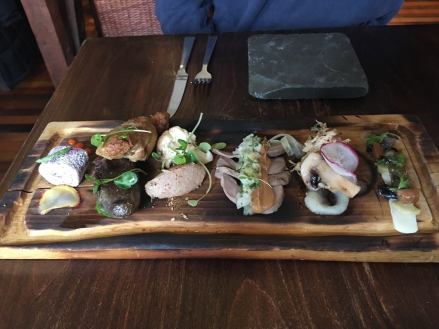
Ben and I attempted to choose a couple starters to share from the starter menu. Turns out, however, that they only serve the entire lot of them on a board to share. No problem! Bring it on! WAF!
I’ll let you struggle over which is which here… Here they are in no particular order: rabbit with olives and herbs, lamb tongue with hazelnuts, sweetbreads on blue potatoes and spinach, razor clam with seaweed, achawal (shredded and spiced chicken) with onion and mushroom, and tongue pate with smoked cauliflower. By now we are wondering what else is to come!
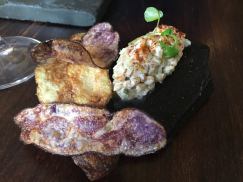

A couple more unanticipated gifts from the kitchen emerged before our entrees. On the left, a variety of thinly sliced potatoes with a sort of slaw made with barley. We were not sure just what the snack on the right was, even after hearing explanations in both English and Spanish. It tasted like a piece of fried fish skin, with an avocado garnish. Sharp and tasty.
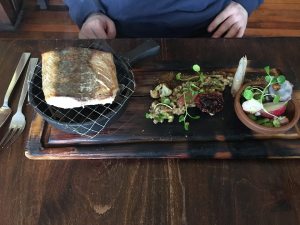
Ben’s entree, a smoked fish, arrived on a small charcoal grill with accompaniments. The filet was a deeper sort of whitefish, reminded me a bit of Mahi Mahi. Served with a variety of condiments made from barley, potatoes, pine nuts and lima beans. This was the first time that we were provided with cutlery during the entire meal! We were amused by the “fish knife” that Ben was given, hardly necessary since it cut nicely with a fork but still a pretty cool looking implement:

Still hungry? Here comes my entree, Rabbit with a variety of indigenous vegetables and lightly fried yucca. The latter is a root crop, firmer and drier than potatoes, found in in various forms in Latin America.

The shredded rabbit, on the left, was dipped into the hot broth on the right. This reminded my of Chinese hot pot, taught to me by Yao Li. Unlike the hot pot experience, there was no heating element below, so the waitress dropped a red hot volcanic rock into the broth, which made it boil. (I have a short video of this but wordpress does not seem to want it…. will post on FB)
One more gift from the kitchen: a palate cleanser. Our best guess was a lightly sweetened vanilla gratinee. Definitely refreshing.
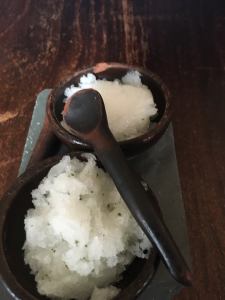
Is it even possible to eat dessert after all of this? Well, we paced ourselves. This was a three hour meal. So yeah, we went there. Dessert is the same plan as appetizers, they put everything on a wooden slat. We asked for espresso but got something better: strong French Press coffee with a syrup derived from the same semi tropical tree that sweetened our lemon bar type appetizer.
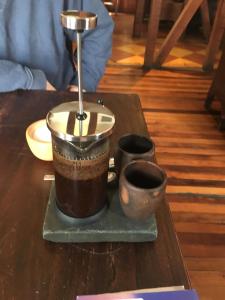
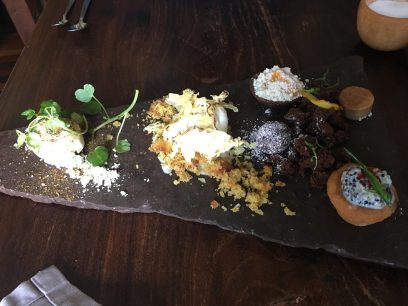
I’ll do my best to follow these down the slab from left to right.
Chañar (local tree nut) ice cream with coca dust (sorry, not the kind that the waiters were using in my 1980s restaurant days). Banana ice cream with dried pineapple and a “poe” streusel, yet another interesting comparative with Tahiti. A sort of chocolate crumble, not sure of the name, but it was like a slightly sweet brownie. Toasted flour and watercress garnishes.
In sum, one of the most interesting and varied meals in recent memory for both of us. Hope you enjoyed this digital version!
Vinos de Mendoza parte II

A few nights ago in Mendoza I spent some time with a wine expert at “Wine Not,” a creatively named tasting room only a block from my hotel. I kept notes on seven wines, discussed below. Please recognize that I am far from an expert and like most of us I just know what I like! Which, in the case of wine, are many different bottles.
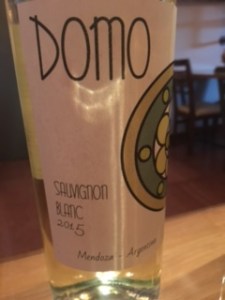
The Domo 2015 Sauvignon Blanc was up first, proof that good wines come out of Mendoza. This one hails from the Uco Valley, the newest region in Mendoza that everyone is excited about because of the experimentation of the boutique wineries. I found it clean and straightforward, on the opposite of the scale of the New Zealand grassy SBs, a trend sometimes followed in the US Northwest IMO. Hints of banana and light citrus and a soft finish. Great for the back porch or lighter dishes.

Next was the Mapu Cura 2015 Chardonnay. Now I’ve had my share of Chards back in my chef days in California, when there was an arms race to see who could get the most oak into the wine. (Sometimes I feel this way about IPAs in the beer world.) Once again the Argentines produced a crisp and only slightly buttery wine, light and a bit earthy. My host claimed that it was due to the soil. Those looking for a fuller body chard, such as the mid priced ones produced in California, will be less satisfied with this one, but I liked its honesty. I’d be afraid to serve anything too rich or creamy with it, however.

Rose. OMG, for years I had no idea that this could be anything more than a picnic wine right up there with Zima (Wabash joke). When I was a chef in the 1980s wineries couldn’t produce enough of the sweet pink stuff. My boss refused to carry it, saying it was tacky. Inevitably some tourists would ask for it and the waiters would mix a sweeter white wine with some red in the back and serve it as house rose! Anyway, times have changed, or perhaps I just never was exposed to roses that were not sugar water. This Marcus Zunida Rosé reminded me of a couple wines I’ve shared with Jim Amidon. Very slight tannin, pretty dry, with a light finish. It would be good by the pool as well as with some poultry dishes, I believe. So this one is made with the Bornardo grape, mentioned in my last post as a red wine.
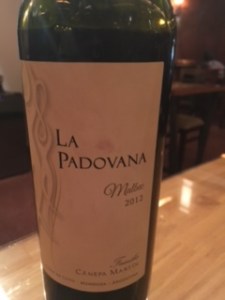
The fourth wine (don’t judge — these were less than half a glass each!) was a 2012 La Padovana Malbac. Well, I’ve had plenty of Malbec purchased at Kroger in the past few years. It’s a good sturdy wine and I can understand why they export so much of it. I actually did not care that much for this one, preferring my “Mendoza” (probably a mix) from the Kroger shelves for a steak. All the same it was interesting. I thought that there was a bifurcated balance between the fruity grape on one side and a sharp tannic bight on the other. It was as if both sides of the spectrum needed to be brought closer. Although it is not that young I did wonder what more time might do for the smooth factor.
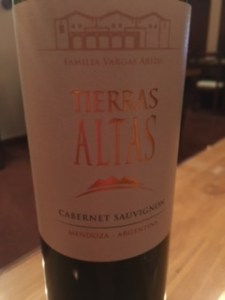
The owner quickly brought me out a Tierras Altas Cabernet. He was quick to note that both wines came from similar soils and conditions in the Luja de Cuyo region, yet this one was smoother with a pleasant light tannin. This would work for many steak as well as pasta dishes, and I am not likely to say that about many wines. It could even handle some spicy food. This is one worth importing IMO. Not as deep as the California cabs that I like to pair with my New York, but a very sturdy and interesting wine.
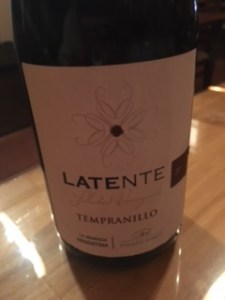
Another big grape in Mendoza is Tempranillo. This 2015 Latente version is quite smooth and ready to drink IMO. The owner noted that the problem with this wine is that it goes down so well you literally could drink it all day! I have no idea what the price point is but my sense is that it is higher that the $9 Malbecs I’ve been buying at Kroger. Who knows… I’ll leave that to the wine experts, Howard!
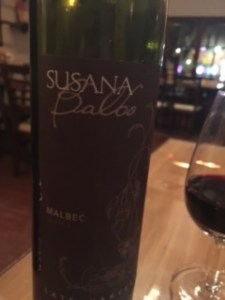
We finished the night with this Susana Balbo Late Harvest Malbec. I remember some late harvest wines from California: they develop a natural sweetness and some higher alcohol content. It’s not fortified and not very sweet but it most definitely is a dessert wine. Chocolate chocolate chocolate. Fourteen out of every ten people like chocolate and many will like this wine with it. The Malbec flavor comes through in this semi-port finisher. Not for savory food but great with dessert or a cigar…. well, not that last one for me but I can think of a few of you who would like that.
Transitions
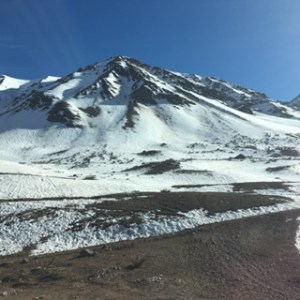
Today I crossed the Andes by bus from Mendoza to Santiago de Chile. Some of you may have seen some pictures of this journey on Facebook. Photos do not capture the beauty and emotion. I made some connections to my research on this trek that I will share in the next post. For now, I leave you with a piece of the beauty that was my day:
Vinos de Mendoza parte I

Winemaking in Mendoza has deep roots that date back to the arrival of Jesuit missionaries in the sixteenth century. Their “criollo” wines were replaced with “noble” varietals from Europe, as immigration picked up in the nineteenth century. This immigration had massive effects on Argentine society, as it rolled into the twentieth century. Much of my project in this region is related to the culinary impact of these immigrants, Italian and otherwise. In Mendoza this produced a vibrant wine industry.
Casual wine shoppers in the U.S. can easily find Argentine wine…. but it is almost always red and usually Malbec. Here’s the big secret: many more varietals are produced in Mendoza! Nearly a third of the wine produced is in fact white, mostly from the northern regions of the province. Today the wine business is booming here, being followed quickly enough by the wine tourism business.
Mendoza wines come from two different “departmentos,” or counties: Maipú and Luján. The latter is the site of the newest area of grape development, Luján de Cuyo and the Uco valley, where new varietals are emerging. This is where many of the newer boutique wineries have spung up.
Enough chatter. Let me tell you about some of the wines that I have tasted in my days here.
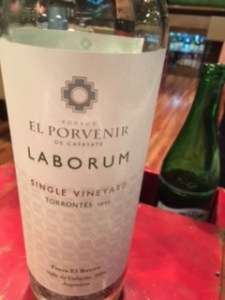
First, a crisp 2015 Torrontes from El Porvenir de Cafayate. Crisp, nice fruit. More body than the sauvignon blanc that I consume on warm afternoons, this should stand up to spicy foods.
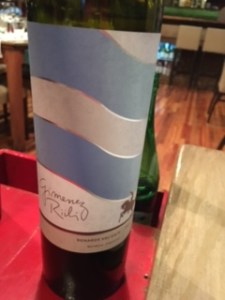
Gimenez Rilli 2015 Bornarda. This once was the most common grape in Mendoza before the rise of Malbec in the last generation or so. Now it’s used for many blends, in the way that Californians use Merlot to soften red blends. Surprisingly soft and subtle wine, with very little tannin. Ready to drink early enough. For me it was reminiscent of pinot noir, without the complexity, and with the lightness of chianti. Definitely a pasta wine. The waiter was surprised that I actually liked it more than the third wine of the tasting:
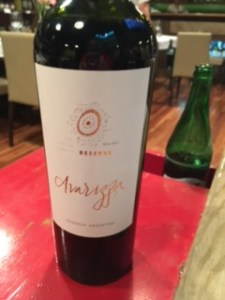
Alvarizza 2012 Malbec. This was great, just not as surprising to me as the previous wine. Rich and smooth, nicely aged though it could improve more with a couple years IMO. Some welcome dregs at the bottom of the glass. Some oak, not too much. I’m beginning to feel like the Argentines do not want to mess too much with the natural flavor of the grape, which I’ve been told can vary according to soil and weather conditions from year to year here. Definitely a great steak wine and it was fun to move back and forth between the malbec and the bornarda with the lamb I was eating.
I consumed the above wines as part of a tasting set with my dinner at Azafran (http://azafranresto.com) an eclectic restaurant defined by international fusions and impeccable service. They insisted on speaking English to me and I finally gave in. Here are some of the food highlights:

Homemade rolls, three varieties and bread sticks with, get this, a compound beet butter. I rarely eat butter with my bread but managed to devour most of this chunk.
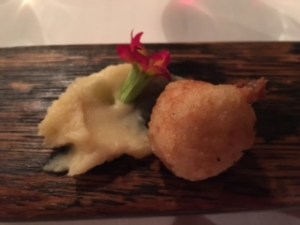
Risotto and mushroom fritter, parsnip puree
This came on the house as an amuse.
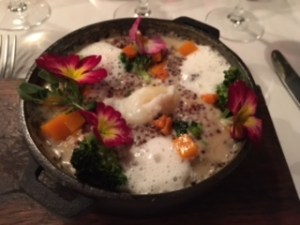
Quail egg (in center) baked with red quinoa and fresh cheese and vegetables. It was like a thick stew. Probably the most unusual dish I have eaten in Argentina.
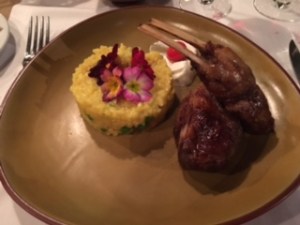
Lamb loin, chimichurri oil sauce, with saffron risotto.

Palate cleanser: raspberry sorbet, just a few tablespoons but perfect for the job.

Finally, a classic creme brûlée with creme anglaise and candied local fruits. The custard had a different flavor which is still stumping me. I had asked enough questions of the waiter that I let that one go.
Well, I am well over 500 words so the rest of the wines will have to wait for the next post. A teaser: there are seven of them that I tasted at a place called “Wine Not” (http://winenotmendoza.com). Not to worry, they were less than half a glass each!
Meeting Mendoza

[View from the street of the open kitchen of Restaurante Florentino in Mendoza. Check out the wood fire oven.]
I continue to eat my way through Argentina. The beef is indeed excellent, though I think even I have had my fill of it… All the same, here is one more pic from a huge slab that I somehow devoured. For the record, I did order it medium rare but it was still very tender in its pre-rare (or as we say in the business, “blue”) state.

Much of today was spent exploring the historical city of Mendoza. At the suggestion of the doña of the casa that I am staying in, Mercedes, I took one of those double decker tour buses on a two hour ride through town. I’ll be honest that I usually turn my nose up at that experience but this proved to be an excellent idea. All the more so since it was about 45 degrees with a wind. Still, I rode upstairs in the open air for much of the time. They provided me with a poncho:

Mendoza was home to the great independence hero of the southern cone (southern South America), San Martín. Less known than Bolívar, he is credited with liberating Argentina, Chile and Peru. The story between the two of these heroes gets a bit complicated after that. Take HIS 252 if you want the full treatment. Mendoza sports a beautiful park, named for their liberator, expertly designed in the late nineteenth century by a Frenchman Carlos Thayes. The bus wound its way to the top of a huge hill, where San Martín is commemorated with a statue for his legendary collection of revolutionary soldiers to cross the Andes to battle the Spaniards:
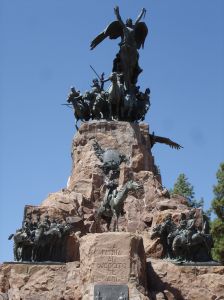
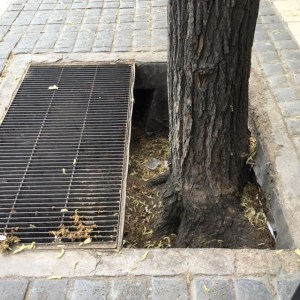
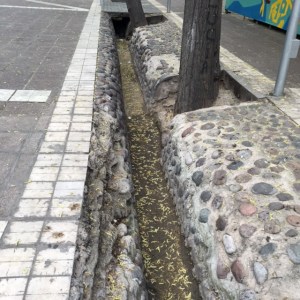
The deeper history of Mendoza makes stronger connections with my project, and will be the subject of further posts. For the time being I will note that the history of wine making in Mendoza (their claim to fame!) began with the Jesuits in the seventeenth century. The Black Robes and subsequent European immigrants learned a great deal about water management from the indigenous Huarpes, about whom I know very little just yet. Mendoza is situated in a semi-arid region, where rainfall is too scarce for grapes. However, the Huarpes had practiced irrigation techniques for years. By the eighteenth century the colonial government had completed a series of irrigation canals that drew off of water from the Andes. This is when wine production began to take off. In sum, this emphasis on irrigation learned from the Huarpes allowed colonial and now national wine industries to develop. In fact, every street of the city is bordered by these ditches, which today provide water for trees that would otherwise perish. Here are a couple pics of this technology:
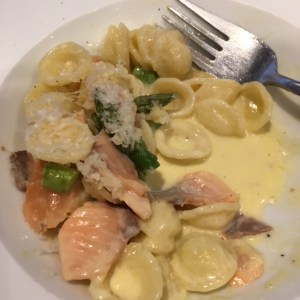
Strong Italian immigration has influenced the cuisine here, and there are other trends as well, which I will feature soon. I will leave you with a portrait of my pasta dish today, which I consumed at a restaurant called Maria Antoinette. More to the story there…
Two Argentinas

Yes, there are vegetables in Argentina as well as meat and pasta! Artichokes (next to red peppers above) are in season. I remember those fondly from central coast California, where they thrive in the 50-60 F weather as they do here. I wonder who brought them here first?
Today I was on a bus for ten hours from Buenos Aires to Córdoba, the second largest city. As a Latin American historian I have long been aware that there are two Argentinas: Buenos Aires and the rest. Some have told me that France is this way as well. In the nineteenth century, porteños held court over the rest of the country, as liberals such as Sarmiento competed with countryside charismatic conservative leaders, or caudillos, like Rosas. Today the differences are not so marked perhaps, though the landscape surely is. Traveling across the long stretch of flat land called the Pampas reminded me of the US Midwest, if flatter:
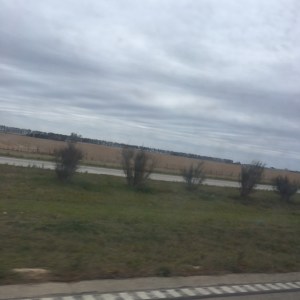
Lots of land for wheat, cattle, and other livestock. The British, who developed these industries a century ago, also saw it as a huge potential polo field. The air is crisp and dry, just the opposite of what I left behind in Indiana less than a week ago.
And yet I made another Hoosier connection, meeting up with Ben Finley ’15 at his “resi” or community house in Córdoba. We feasted on empanadas (I still have not spent a day without beef) and chatted with his Argentine housemates, most of whom were nervously watching their soccer team narrowly defeat Uruguay.
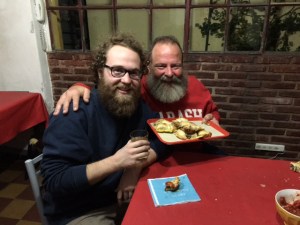
As I finished my last empanada I recognized that the two principal ingredients — wheat and beef — dominate the landscape for kilometers in each direction. And like much of Argentina, these foodstuffs were immigrants, brought by Europeans centuries ago. These migrations and new cuisines are the main ingredients in my research, as will be seen if you continue to follow my musings here!
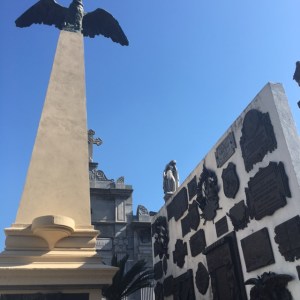
Back to BA one last time. I visited the Recoleta cemetery, a maze of mausoleum structures that date back over the last couple of cemeteries. Many key public leaders are represented, from politicians to the elite classes of previous generations. No two structures are alike, for example some have votive tables set up behind ancient glass, and some have stairs that travel into the netherlands.
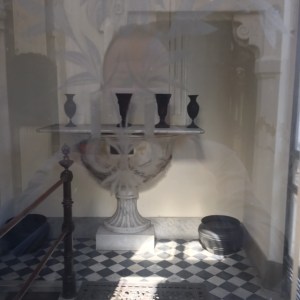
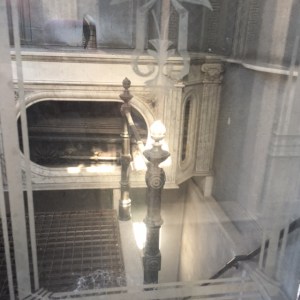
There is a map, but only one site has actual signs that lead to it, that of President Domingo Sarmiento. Interesting that I could not find Rosas. Here is the final resting place of Sarmiento:
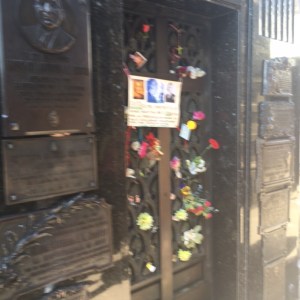
And finally, I believe that many of you will be able to guess which famous twentieth century woman was laid to rest here:
Tomorrow: some more connections I have been making between my reading and my immersion learning. ¡Buenas noches!
 Chef Warner Stories